
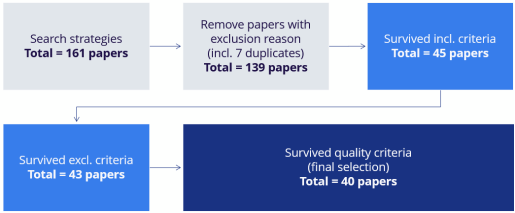
Software startups operate under extreme uncertainty and financial pressure, making Requirements Prioritization (RP) a critical activity for improving survival prospects. This study investigates which prioritization criteria are most relevant to early-stage ventures by conducting a systematic literature review (SLR) of 40 studies and analyzing 358 RP references encompassing 82 distinct criteria across 10 categories. Additionally, we conducted 34 semi-structured interviews with founders from 19 software startups to compare academic insights with real-world practices. The analysis reveals a substantial gap between scholarly emphasis and practitioner needs: while "expected cost" is the most frequently cited criterion in the literature, criteria related to financial impact—such as return on investment, cash flow, and time to value—are underrepresented despite being consistently cited by the most successful startups in our sample. Notably, the criterion "Time to Value," absent from all reviewed literature, emerged as a key factor among practitioners. These findings highlight the need for a more financially grounded and context-sensitive approach to RP in startup environments. The study concludes with a call for greater alignment between academic frameworks and the realities faced by early-stage software ventures, especially in economically challenging conditions.
| Published in | International Journal of Sustainability Management and Information Technologies (Volume 11, Issue 1) |
| DOI | 10.11648/j.ijsmit.20251101.14 |
| Page(s) | 45-66 |
| Creative Commons |
This is an Open Access article, distributed under the terms of the Creative Commons Attribution 4.0 International License (http://creativecommons.org/licenses/by/4.0/), which permits unrestricted use, distribution and reproduction in any medium or format, provided the original work is properly cited. |
| Copyright |
Copyright © The Author(s), 2025. Published by Science Publishing Group |
Startups, Requirements Prioritization, Requirements Prioritization Criteria, Requirements Engineering, Product Management
Research Question | Purpose | |
|---|---|---|
RQ1 | Are there scholarly investigations that address the activities associated with RPC? | To identify existing scholarly investigations focusing on activities related to RPC, which is essential for understanding the existing body of literature and identifying research gaps, providing a foundation for the SLR. |
RQ2 | What are the RPC that could be considered by a Product Manager when shaping its process? | To determine the range of RPC that Product Managers can consider, enhancing decision-making and aligning product development with business goals, crucial for software startups' success. |
RQ2.1 | How is the distribution of identified criteria across publications represented in terms of frequency? | To analyze the frequency and distribution of RPC in academic publications, helping identify the most emphasized factors and guiding researchers and practitioners to focus on widely recognized criteria. |
RQ2.2 | What are the RPC that are discussed in the retained publications? | To identify and summarize the specific RPC discussed in the selected academic publications, providing insights into the various factors considered in decision-making and helping identify common themes, trends, and gaps in literature. |
RQ3 | Which studies within the literature also consider the context of software startups? | To identify studies addressing the context of software startups in relation to RPC, highlighting unique challenges and dynamics, and offering targeted insights and evidence-based guidance for startup decision-makers. |
RQ3.1 | What are the RPC that are highlighted in academic research that are especially taking into account the software startup context? | To explore RPC highlighted in research considering the software startup context, helping tailor RP processes to their unique needs and enhancing decision-making effectiveness. |
RQ3.2 | Do the RPC uncovered through scholarly investigations differ from reality shared by software startup founders? | To compare the RPC identified in academic research with those reported by software startup founders, revealing potential gaps or alignments between theory and practice, and informing more contextually relevant and effective prioritization approaches for early-stage ventures. |
RQ3.3 | Do the RPC that are highlighted in software startup research, appropriate in an era of rising interest rates? | To evaluate the suitability of RPC in the context of rising interest rates, providing insights into their effectiveness in mitigating risks and aiding startups in adapting RP strategies for financial sustainability. |
RQ3.4 | What Requirements Prioritization Criteria show the most promise to improve decision-making at software startups in a more economic challenging context? | To identify RPC that promise to improve decision-making in challenging economic contexts, aiding startups in making efficient decisions and ensuring resilience in economically challenging times. |
IC | Inclusion criteria | 1 | 0.5 | 0 |
|---|---|---|---|---|
1 | Reports on requirements prioritization criteria | In-depth (multiple criteria) | Basic (single criterium) | None |
2 | Reports on context | Startup | General | None |
3 | Reports results of the prioritization efforts | Explicitly mentioned | Basic | None |
4 | Paper within the Requirements Engineering domain | Explicitly mentioned | Linked | No |
5 | Paper related to software products | Software | General | Other |
Exclusion criteria | 1 | 0.5 | 0 | |
|---|---|---|---|---|
1 | Year of publication before 1983 | >= 1983 | N/A | Before 1983 |
2 | There is no PDF file available | PDF available | N/A | No available |
Quality assessment criteria | 2 | 1 | 0 | |
|---|---|---|---|---|
QAC1 | Citations | Citations >= 100 (top 2%) | C between 100 AND 5 | C < 5 (lower 50%) |
QAC2 | Number of references | #ref >= 25 | #ref between 25 AND 10 | #ref < 10 |
QAC3 | Is the proposed methodology (criteria) clearly explained? | Yes | Moderate | No |
QAC4 | Is the evaluation of proposed criterai on adequate case studies, subjects or project data sets? | Subjects >10 | Subjects between 10 AND 4 | Subjects <4 |
QAC5 | Is the result of the study clearly stated? | Yes | Moderate | No |
ID | Role | Sector | Interviews | Years in business | For profit? |
|---|---|---|---|---|---|
S1 | Co-founder & CTO | Football data analytics | 1 (1h15) | 3 | Yes |
S2 | Co-founder & CTO | Security platform | 2 (2h07) | 2 | Yes |
S3 | CEO | AI for mobile mapping | 2 (0h57) | 7 | Yes |
S4 | Founder & Product Manager | Web3 SocialFi | 3 (2h45) | 3 | Yes |
S5 | CEO & co-founder | PLG platform | 2 (1h13) | 4 | Yes |
S6 | Co-owner | Legal tech | 2 (2h35) | 5 | Yes |
S7 | Co-founder | HR tech | 1 (0h45) | 2 | Yes |
S8 | Founder | Logistical solution | 1 (1h25) | 3 | Yes |
S9 | Co-founder | Form builder | 3 (3h24) | 3 | Yes |
S10 | Co-founder & CTO | Web2 credit market | 2 (1h45) | 3 | Yes |
S11 | CEO | HR tech | 3 (2h53) | 3 | Yes |
S12 | CEO & founder | Healthcare platform | 2 (1h48) | 2 | Yes |
S13 | Co-owner | HR tech | 2 (1h15) | 3 | Yes |
S14 | CEO & founder | HR tech | 1 (2h11) | 3 | Yes |
S15 | CEO & co-founder | Data document management | 3 (2h41) | 3 | Yes |
S16 | Founder | Fashion tech | 1 (0h58) | 2 | Yes |
S17 | CEO & co-founder | AI for trends analysis | 1 (1h23) | 4 | Yes |
S18 | Co-founder | HR tech | 1 (0h51) | 4 | Yes |
S19 | Co-founder | HR-tech | 1 (1h34) | 2 | No |
Requirements Prioritization Criteria | % of all citations |
|---|---|
Expected cost (incl. development) | 12.75% |
Risks (incl. dev, business, failure...) | 6.18% |
Resource constraints (incl. HR) | 5.98% |
Dependencies (incl. requirements, customers, technical...) | 5.78% |
Time constraints | 4.98% |
Stakeholder preferences | 4.58% |
Business value | 4.18% |
Customer value | 2.79% |
Value (generic) | 2.79% |
Estimated expected revenue | 2.79% |
Category | Criteria | Count cited |
|---|---|---|
Cost-Related Factors: includes criteria related to budget, cost constraints, cost-benefit analysis, costs of not implementing a requirement, development costs, and cost of maintenance. | Expected cost (incl. development) Budget constraints Cost benefit ratio Efficiency (incl. decreasing costs) Maintenance Budget process Cost of taken no action Cost importance ratio | 94 (18.73%) |
Revenue and Financial Impact: covers criteria such as revenue generation, financial benefits, profitability, return on investment (ROI), and net present value. | Estimated expected revenue Value (generic) Profitability Financial value Return on investment (ROI) Payback period Net present value (NPV) Break-even point Cash flow analysis Internal rate of return (IRR) | 57 (11.35%) |
Business and Strategic Impact: encapsulates criteria related to business goals, strategic benefits, market share estimates, competitive differentiation, and alignment with product strategy. | Business value Estimated market share Competitive intensity Strategy alignment MVP feature set coverage Strategic value Signed contracts Market maturity (incl. growth rate) Proprietary position Cultural alignment Brand value Company synergies Need to demonstrate product Existence of market need Feature promised | 58 (11.55%) |
Stakeholder and Customer Considerations: comprises criteria related to customer needs, customer value, stakeholder value, stakeholder preferences, and customer satisfaction. | Stakeholder preferences Customer value Importance User satisfaction Change management User engagement Contribution to user task User loyalty Frequency of use Communication Partnership | 60 (11.95%) |
Category | Criteria | Count cited |
|---|---|---|
Technical Factors and Constraints: includes criteria related to technical feasibility, complexity of development, technology constraints, product technology, and testability | Complexity Technical constraints Code change Re-usability Modifiability Redundancy (incl. data) Technology Compatibility (incl. technical) Scalability Standards | 27 (5.38%) |
Resource Constraints and Availability: covers criteria such as resource constraints, availability of human resources, skilled personnel, and other re-sources. | Resource constraints (incl. HR) | 30 (5.89%) |
Quality and Performance Metrics: encompasses criteria like quality of service, performance, reliability, maintainability, and error rates. | Quality of service Easy to use Documentation quality Level of ambiguity User experience Reduce errors Reliability Consistency Durability Traceability Testability Non-functional characteristics | 35 (6.97%) |
Category | Criteria | Count cited |
|---|---|---|
Risk Assessment: incorporates criteria related to risks, including development risks, business risks, risk of failure, and risk of implementing a feature. | Risks (incl. dev, business, failure...) Penalties Prioritization (incl. features, bugs) Predictability (incl. commercial, info) Volatility Security Feasibility Regulations Legal mandate Harm avoidance Issues | 74 (14.74%) |
Time Constraints and Scheduling: includes criteria related to development time, time to market, delivery time, and scheduling constraints. | Time constraints Time to market | 37 (7.37%) |
Dependency and Interdependency Factors: Covers criteria such as dependencies between requirements, feature dependencies, and requirement precedence constraints. | Dependencies (incl. requirements, customers, technical...) Similarity | 30 (5.98%) |
= 502 (100%) |
Ref. | Cited RP criteria |
|---|---|
[ 35] | Profitability |
[72] | Predictability (incl. commercial, info), Return on investment (ROI), Risks (incl. dev, business, failure...) |
[73] | Complexity, expected cost (incl. Development), Time to market |
[74] | Business value, Change management, Dependencies (incl. requirements, customers, technical...), Expected cost (incl. development), MVP feature set coverage, Resource constraints (incl. HR), Risks (incl. dev, business, failure...) |
[75] | Expected cost (incl. development), Financial value, Value (generic) |
[76] | Budget constraints, Risks (incl. dev, business, failure...), Time constraints, Time to market |
[77] | Customer value, Expected cost (incl. development), Risks (incl. dev, business, failure...) |
[40] | Expected cost (incl. development), Feasibility, Quality of service, Time constraints |
[78] | Business value |
[66] | Business value, Expected cost (incl. development), Return on investment (ROI), Stakeholder preferences, Value (generic) |
[65] | Cost benefit ratio, Expected cost (incl. development), Maintenance, Resource constraints (incl. HR), Time constraints |
[79] | Cultural alignment |
[20] | Cost benefit ratio, Customer value, Dependencies (incl. requirements, customers, technical...), Expected cost (incl. development), MVP feature set coverage, Need to demonstrate product, Prioritization (incl. features, bugs), Stakeholder preferences, Strategy alignment |
[80] | Business value, Customer value, Dependencies (incl. requirements, customers, technical...), Easy to use, Efficiency (incl. decreasing costs), Estimated expected revenue, Expected cost (incl. development), Prioritization (incl. features, bugs), Profitability, Quality of service, Reduce errors, Resource constraints (incl. HR), Time to market, User engagement |
[81] | Customer value |
[82] | Budget constraints, Quality of service, Time constraints, Time to market |
[83] | Dependencies (incl. requirements, customers, technical...), Expected cost (incl. development), Importance, Penalties, Risks (incl. dev, business, failure...), Time constraints, Volatility |
Ref. | Cited RP criteria |
|---|---|
[64] | Budget constraints, Cost benefit ratio, Customer value, Dependencies (incl. requirements, customers, technical...), Expected cost (incl. development), Risks (incl. dev, business, failure...), Time constraints |
[84] | Cost importance ratio, Expected cost (incl. development), Importance |
[33] | Financial value, Resource constraints (incl. HR), Stakeholder preferences, Strategic value, Time constraints |
[85] | Dependencies (incl. requirements, customers, technical...), Expected cost (incl. development), Importance, Stakeholder preferences |
[86] | Competitive intensity, Customer value, Estimated market share, Expected cost (incl. development), Financial value, Penalties, Risks (incl. dev, business, failure...), Time constraints, User engagement, Value (generic) |
[29] | Expected cost (incl. development), Quality of service, Resource constraints (incl. HR), Time constraints |
[87] | Business value, Customer value, Dependencies (incl. requirements, customers, technical...), Expected cost (incl. development), Penalties, Risks (incl. dev, business, failure...), Time constraints, Value (generic) |
[32] | Customer value, Dependencies (incl. requirements, customers, technical...), Expected cost (incl. development), Prioritization (incl. features, bugs) |
[38] | Customer value, Resource constraints (incl. HR), Technical constraints, Time constraints |
[88] | Documentation quality, Efficiency (incl. decreasing costs), Estimated expected revenue, Expected cost (incl. development), Reduce errors, Time constraints |
[89] | Budget constraints, Competitive intensity, Customer value, Expected cost (incl. development), Regulations, Time constraints, User satisfaction |
[37] | Budget constraints, Business value, Complexity, Consistency, Customer value, Dependencies (incl. requirements, customers, technical...), Easy to use, Estimated expected revenue, Expected cost (incl. development), Feasibility, Importance, Level of ambiguity, Maintenance, Modifiability, Penalties, Predictability (incl. commercial, info), Prioritization (incl. features, bugs), Quality of service, Redundancy (incl. data), Reliability, Resource constraints (incl. HR), Re-usability, Risks (incl. dev, business, failure...), Security, Stakeholder preferences, Technical constraints, Technology, Testability, Time constraints, Traceability, User satisfaction, Value (generic), Volatility |
Ref. | Cited RP criteria |
|---|---|
[90] | Competitive intensity, Cost of taken no action, Dependencies (incl. requirements, customers, technical...), Expected cost (incl. development), Financial value, MVP feature set coverage, Predictability (incl. commercial, info), Regulations, Resource constraints (incl. HR), Signed contracts, Stakeholder preferences, Strategy alignment, Time to market |
[60] | Change management, Competitive intensity, Complexity, Cost benefit ratio, Dependencies (incl. requirements, customers, technical...), Estimated expected revenue, Feature promised, Maintenance, Profitability, Resource constraints (incl. HR), Signed contracts, Stakeholder preferences, Time to market, Volatility |
[91] | Company synergies, Competitive intensity, Complexity, Durability, Existence of market need, Market maturity (incl. growth rate), Payback period, Predictability (incl. commercial, info), Profitability, Proprietary position, Regulations, Resource constraints (incl. HR), Strategic value, Strategy alignment, Time to market |
[92] | Estimated expected revenue, Expected cost (incl. development), Partnership, Return on investment (ROI), Stakeholder preferences |
[93] | Business value, Customer value, Expected cost (incl. development), Non-functional characteristics, Strategy alignment |
[94] | Prioritization (incl. features, bugs) |
[95] | Return on investment (ROI) |
[96] | Budget process, Estimated expected revenue, Financial value, Internal rate of return (IRR), Payback period, Profitability, Return on investment (ROI) |
[97] | Cash flow analysis, Estimated expected revenue, Estimated market share, Expected cost (incl. development), Financial value, Profitability |
[46] | Break-even point |
[70] | Budget constraints, Business value, Complexity, Customer value, Dependencies (incl. requirements, customers, technical...), Estimated expected revenue, Expected cost (incl. development), Financial value, Penalties, Prioritization (incl. features, bugs), Quality of service, Resource constraints (incl. HR), Risks (incl. dev, business, failure...), Stakeholder preferences, Technical constraints, Time constraints, Time to market, Value (generic), Volatility |
Ref. | Title | Startup? |
|---|---|---|
[74] | Agile requirements prioritization in large-scale outsourced system projects: An empirical study | |
[66] | Prioritization of quality requirements: State of practice in eleven companies | |
[20] | A model of requirements engineering in software startups | X |
[80] | An anatomy of requirements engineering in software startups using multi-vocal literature and case survey | X |
[81] | Towards prioritizing software business requirements in startups | X |
[83] | Challenges and future trends in software requirements prioritization | |
[64] | Do we know enough about requirements prioritization in agile projects: insights from a case study | |
[84] | Supporting the selection of software requirements | |
[85] | A comparison of nine basic techniques for requirements prioritization | |
[29] | A systematic literature review of software requirements prioritization research | |
[87] | Value-oriented requirements prioritization in a small development organization | |
[60] | A product management challenge: Creating software product value through requirements selection |
Startup Requirements Prioritization Criteria | % of all citations |
|---|---|
Expected cost (incl. development) | 11.54% |
Customer value | 11.54% |
Dependencies (incl. requirements, customers, technical...) | 7.69% |
Prioritization (incl. features, bugs) | 7.69% |
Efficiency (incl. decreasing costs) | 7.69% |
Startup Requirements Prioritization Categories | % of all citations |
|---|---|
Cost-Related Factors | 23.08% |
Stakeholder and Customer Considerations | 19.23% |
Business and Strategic Impact | 15.38% |
Quality and Performance Metrics | 11.54% |
Dependency and Interdependency Factors | 7.69% |
Risk Assessment | 7.69% |
Revenue and Financial Impact | 7.69% |
Time Constraints and Scheduling | 3.85% |
Resource Constraints and Availability | 3.85% |
Requirements Prioritization Categories | Requirements Prioritization Criteria | Startup id | In SLR? |
|---|---|---|---|
Cost-Related Factors | Expected cost (including development days) | S1, S2, S9, S10, S11, S12, S15, S16 and S17 | Yes |
Business and Strategic Impact | Strategic alignment | S4, S5, S14, S16 and S17 | Yes |
Time Constraints and Scheduling | Time to Value (TtV) | S2, S8, S9, S10, S11, S12 and S15 | No |
Time Constraints and Scheduling | Time to Market (TtM) | S1, S2, S4, S8, S9 and S10 | Yes |
Revenue and Financial Impact | Business case (including expected revenue and ROI) | S2, S9, S11, S12, S15, and S17 | Yes |
Stakeholder and Customer Considerations | Stakeholder preferences (informal user discussions) | S8, S9 S12, S14 and S17 | Yes |
Stakeholder and Customer Considerations | Stakeholder preferences (count of user requests) | S8, S9, S10, S11, S14, S15 and S17 | Yes |
Paper | Financial ratio |
|---|---|
Boehm [72] | Return on investment (ROI) |
Svensson et al. [66] | Return on investment (ROI) |
Cleland-Huang and Denne [98] | Net present value (NPV) |
Cooper [90] | Payback period |
Bekkers et al. [92] | Return on investment (ROI) |
Fogelstrom et al. [95] | Return on investment (ROI) |
Gorchels [96] | Return on investment (ROI), Internal rate of return (IRR), Payback period |
Cosse and Swan [97] | Cash flow analysis |
Guyon and Elisseeff [46] | Break-even point |
RP | Requirements Prioritization |
MVP | Minimum Viable Product |
RE | Requirements Engineering |
TP | Task Prioritization |
MAUT | Multi-Attribute Utility Theory |
AHP | Analytic Hierarchy Process |
CBR | Case Based Reasoning |
DEA | Data Envelopment Analysis |
SMART | Specific, Measurable, Achievable, Relevant, Time-bound – Context not Clarified in Text but Likely This Meaning |
ELECTRE | ELimination Et Choix Traduisant la REalité |
PROMETHEE | Preference Ranking Organization METHod for Enrichment Evaluation |
SAW | Simple Additive Weighting |
TOPSIS | Technique for Order of Preference by Similarity to Ideal Solution |
BST | Binary Search Tree |
VOP | Value Oriented Prioritization |
FG | Fuzzy RDF FG (Likely Fuzzy Graph-based, Specific Meaning Unclear) |
QFD | Quality Functional Development |
AIRM | Aggregated Indices Randomization Method |
SLR | Systematic Literature Review |
RPC | Requirements Prioritization Criteria |
RQ | Research Question |
IC | Inclusion Criteria |
QAC | Quality Assessment Criteria |
IRR | Internal Rate of Return |
NPV | Net Present Value |
ROI | Return on Investment |
CFA | Cash Flow Analysis |
| [1] | Giardino, C., et al. Key challenges in early-stage software startups. in International conference on agile software development. 2015. Springer. |
| [2] |
Flint, M. Small business cash flow management: Strategies for success. 2023 29/11/2023]; Available from:
https://preferredcfo.com/cash-flow-reason-small-businesses-fail/ |
| [3] | Fatema, K., M. Syeed, and M. S. U. Miah, Demography of startup software companies: an empirical investigation on the success and failure. International Journal of Computer Applications, 2020. 975: p. 8887. |
| [4] | Kotashev, K., Startup Failure Rate: How Many Startups Fail and Why. Failory. Consultado el, 2022. 28. |
| [5] |
Kolmar, C. 20+ must-know startup statistics [2023]: Average time to reach profitability at a startup. 2023 19/7/2023]; Available from:
https://www.zippia.com/advice/start-up-profitability-statistics |
| [6] | Pattyn, F. Preliminary Structured Literature Review Results Using ChatGPT: Towards a Pragmatic Framework for Product Managers at Software Startups. in 2023 IEEE 31st International Requirements Engineering Conference Workshops (REW). 2023. IEEE. |
| [7] | Crowne, M. Why software product startups fail and what to do about it. Evolution of software product development in startup companies. in IEEE International engineering management conference. 2002. IEEE. |
| [8] | Tokarev, B. Comparative Analysis of the Product Management Application in Startups of Different Types. in Proceedings of the International Scientific Conference “Smart Nations: Global Trends In The Digital Economy” Volume 1. 2022. Springer. |
| [9] | Eisenmann, T. R., Determinants of early-stage startup performance: Survey results. Harvard Business School Entrepreneurial Management Working Paper, 2020(21-057). |
| [10] |
Insights, C. Top 12 reasons startups fail. 2023 25/6/2023]; Available from:
https://www.cbinsights.com/research/startup-failure-reasons-top |
| [11] | Klotins, E., Software Engineering in Start-up Companies. Ph.D. thesis, in Department of Software Engineering. 2019. |
| [12] | Nyimbili, F. and L. Nyimbili, Types of Purposive Sampling Techniques with Their Examples and Application in Qualitative Research Studies. British Journal of Multidisciplinary and Advanced Studies, 2024. 5(1): p. 90-99. |
| [13] | Pattyn, F., Improving Software Startup Viability: Addressing Requirements Prioritization Challenges Amid Increasing Interest Rates. 14th International Conference on Software Business (ICSOB), 2023 |
| [14] | Pattyn, F. and Usman R. Smart Scaling for Software Startups Through Financial Requirements Prioritization Criteria. in 2025 15th International Conference of Software Business (ICSOB). 2025. |
| [15] | Pattyn, F. The Hidden Costs of Ignoring Cash Flow: A Call for Strategic Requirements Prioritization at Startups during an Era of Rising Interest Rates. in IEEE 31st International Requirements Engineering Conference Workshops (REW). 2023. IEEE. |
| [16] | Chang, Y. and W. M. Kock, Credit Guarantee Scheme and Startup Businesses: Financial Pipelines and Successful Startups in South East Asia, in Investment in Startups and Small Business Financing. 2021, World Scientific. p. 265-302. |
| [17] | Ogujiuba, K. K., et al., SMEs, success, and capital startups: Evidence from the service sector in South Africa. Administrative Sciences, 2023. 13(5): p. 127. |
| [18] | Korpysa, J., U. S. Singh, and S. Singh, Decision Criteria and Determining Factors Importance Validation Advocating Sustainability of Entrepreneurial Startups for Social Inclusion and Capacity Building. 2023. |
| [19] | Nuseibeh, B. and S. Easterbrook. Requirements engineering: a roadmap. in Proceedings of the Conference on the Future of Software Engineering. 2000. |
| [20] | Melegati, J., et al., A model of requirements engineering in software startups. Information and software technology, 2019. 109: p. 92-107. |
| [21] | Bambazek, P., I. Groher, and N. Seyff, Requirements engineering for sustainable software systems: a systematic mapping study. Requirements Engineering, 2023. 28(3): p. 481-505. |
| [22] | Fricker, S. A., R. Grau, and A. Zwingli, Requirements engineering: best practice. 2015, Springer. |
| [23] | Svensson, R. B. and R. Torkar, Not all requirements prioritization criteria are equal at all times: A quantitative analysis. Journal of Systems and Software, 2024. 209: p. 111909. |
| [24] | Bugayenko, Y., et al., Prioritizing tasks in software development: A systematic literature review. Plos one, 2023. 18(4): p. e0283838. |
| [25] | Alhenawi, E., et al., Choosing a Suitable Requirement Prioritization Method: A Survey. arXiv preprint arXiv: 2402.13149, 2024. |
| [26] | Winton, J. and F. Palma, Improving Software Requirements Prioritization through the Lens of Constraint Solving. arXiv preprint arXiv: 2306.12391, 2023. |
| [27] | Noviyanto, F., R. Razali, and M. Z. Ahmad Nazri, Understanding requirements dependency in requirements prioritization: a systematic literature review. International Journal of Advances in Intelligent Informatics, 2023. 9(2). |
| [28] | Rehman, S. U., M. Aoun, and A. Qayoom, Selection Criteria for Requirement Prioritization Techniques for software development: Data Analysis. The Asian Bulletin of Big Data Management, 2023. 3(2): p. 201-215. |
| [29] | Achimugu, P., et al., A systematic literature review of software requirements prioritization research. Information and software technology, 2014. 56(6): p. 568-585. |
| [30] | Velasquez, M. and P. T. Hester, An analysis of multi-criteria decision making methods. International journal of operations research, 2013. 10(2): p. 56-66. |
| [31] | Racheva, Z., et al. A conceptual model and process for client-driven agile requirements prioritization. in 2010 Fourth International Conference on Research Challenges in Information Science (RCIS). 2010. IEEE. |
| [32] | Herrmann, A. and M. Daneva. Requirements prioritization based on benefit and cost prediction: an agenda for future research. in 2008 16th IEEE International Requirements Engineering Conference. 2008. IEEE. |
| [33] | Perini, A., et al. An empirical study to compare the accuracy of AHP and CBRanking techniques for requirements prioritization. in 2007 Fifth International Workshop on Comparative Evaluation in Requirements Engineering. 2007. IEEE. |
| [34] | Ma, Y., et al., Requirements prioritization for complex products based on fuzzy associative predicate representation learning. Advanced Engineering Informatics, 2024. 62: p. 102621. |
| [35] | Gordijn, J. and J. Akkermans, Value-based requirements engineering: exploring innovative e-commerce ideas. Requirements engineering, 2003. 8(2): p. 114-134. |
| [36] | Trieflinger, S., et al. How to prioritize your product roadmap when everything feels important: a grey literature review. in 2021 IEEE International Conference on Engineering, Technology and Innovation (ICE/ITMC). 2021. IEEE. |
| [37] | Hujainah, F., et al., Software requirements prioritisation: a systematic literature review on significance, stakeholders, techniques and challenges. IEEE Access, 2018. 6: p. 71497-71523. |
| [38] | Tonella, P., A. Susi, and F. Palma, Interactive requirements prioritization using a genetic algorithm. Information and software technology, 2013. 55(1): p. 173-187. |
| [39] | Racheva, Z., M. Daneva, and L. Buglione. Supporting the dynamic reprioritization of requirements in agile development of software products. in 2008 Second International Workshop on Software Product Management. 2008. IEEE. |
| [40] | Ruhe, G., A. Eberlein, and D. Pfahl, Trade-off analysis for requirements selection. International Journal of Software Engineering and Knowledge Engineering, 2003. 13(04): p. 345-366. |
| [41] | Khan, S. U. R., et al., RePizer: a framework for prioritization of software requirements. Frontiers of Information Technology & Electronic Engineering, 2016. 17: p. 750-765. |
| [42] | Achimugu, P., A. Selamat, and R. Ibrahim. A clustering based technique for large scale prioritization during requirements elicitation. in Recent Advances on Soft Computing and Data Mining: Proceedings of The First International Conference on Soft Computing and Data Mining (SCDM-2014) Universiti Tun Hussein Onn Malaysia, Johor, MalaysiaJune 16th-18th, 2014. 2014. Springer. |
| [43] | Aasem, M., M. Ramzan, and A. Jaffar. Analysis and optimization of software requirements prioritization techniques. in 2010 International Conference on Information and Emerging Technologies. 2010. IEEE. |
| [44] | Mardani, A., et al., Multiple criteria decision-making techniques and their applications–a review of the literature from 2000 to 2014. Economic research-Ekonomska istraživanja, 2015. 28(1): p. 516-571. |
| [45] | Aruldoss, M., T. M. Lakshmi, and V. P. Venkatesan, A survey on multi criteria decision making methods and its applications. American Journal of Information Systems, 2013. 1(1): p. 31-43. |
| [46] | Guyon, I. and A. Elisseeff, An introduction to variable and feature selection. Journal of machine learning research, 2003. 3(Mar): p. 1157-1182. |
| [47] | Muhammad, A., et al., Prioritizing non-functional requirements in agile process using multi criteria decision making analysis. IEEE Access, 2023. 11: p. 24631-24654. |
| [48] | Ma, Q., The effectiveness of requirements prioritization techniques for a medium to large number of requirements: a systematic literature review. 2009, Auckland University of Technology. |
| [49] | Gupta, V., et al., Requirements engineering in software startups: A systematic mapping study. Applied Sciences, 2020. 10(17): p. 6125. |
| [50] | Kitchenham, B., Procedures for performing systematic reviews. Keele, UK, Keele University, 2004. 33(2004): p. 1-26. |
| [51] | Brereton, P., et al., Lessons from applying the systematic literature review process within the software engineering domain. Journal of systems and software, 2007. 80(4): p. 571-583. |
| [52] | Kitchenham, B., et al., Systematic literature reviews in software engineering–a systematic literature review. Information and software technology, 2009. 51(1): p. 7-15. |
| [53] | Al-Moslmi, T., et al., Approaches to cross-domain sentiment analysis: A systematic literature review. Ieee access, 2017. 5: p. 16173-16192. |
| [54] | Ernst, H., Success factors of new product development: a review of the empirical literature. International journal of management reviews, 2002. 4(1): p. 1-40. |
| [55] | Weingart, S., How many citations does a paper have to get before it's significantly above baseline impact for the field. 2012. |
| [56] | Krishnan, V. and K. T. Ulrich, Product development decisions: A review of the literature. Management science, 2001. 47(1): p. 1-21. |
| [57] | Úcar Marqués, I., et al., Growth in the number of references in engineering journal papers during the 1972-2013 period. Scientometrics, 2014, 98, 1855-1864, 2014. |
| [58] | Cheng, B. H. and J. M. Atlee, Research directions in requirements engineering. Future of software engineering (FOSE'07), 2007: p. 285-303. |
| [59] | Rodriguez, P., C. Urquhart, and E. Mendes, A theory of value for value-based feature selection in software engineering. IEEE Transactions on Software Engineering, 2020. 48(2): p. 466-484. |
| [60] | Barney, S., A. Aurum, and C. Wohlin, A product management challenge: Creating software product value through requirements selection. Journal of Systems Architecture, 2008. 54(6): p. 576-593. |
| [61] | Goknil, A., I. Kurtev, and K. van den Berg. A metamodeling approach for reasoning about requirements. in Model Driven Architecture–Foundations and Applications: 4th European Conference, ECMDA-FA 2008, Berlin, Germany, June 9-13, 2008. Proceedings 4. 2008. Springer. |
| [62] | Cox, K., M. Niazi, and J. Verner, Empirical study of Sommerville and Sawyer's requirements engineering practices. IET software, 2009. 3(5): p. 339-355. |
| [63] | Lubars, M., C. Potts, and C. Richter. A Review of the State of the Practice in Requirements Modeling. in [1993] Proceedings of the IEEE International Symposium on Requirements Engineering. 1993. IEEE. |
| [64] | Racheva, Z., et al. Do we know enough about requirements prioritization in agile projects: insights from a case study. in 2010 18th IEEE International Requirements Engineering Conference. 2010. IEEE. |
| [65] | Wohlin, C. and A. Aurum, Criteria for selecting software requirements to create product value: An industrial empirical study. Value-based software engineering, 2006: p. 179-200. |
| [66] | Svensson, R. B., et al. Prioritization of quality requirements: State of practice in eleven companies. in 2011 IEEE 19th international requirements engineering conference. 2011. IEEE. |
| [67] | Baskerville, R., J. Travis, and D. P. Truex. Systems without method: The impact of new technologies on information systems development projects. in Proceedings of the IFIP WG8. 2 Working Conference on The Impact of Computer Supported Technologies in Information Systems Development. 1992. |
| [68] | Inayat, I., et al., A systematic literature review on agile requirements engineering practices and challenges. Computers in human behavior, 2015. 51: p. 915-929. |
| [69] | Pattyn, F., Supporting technical paper, including the review protocol regarding a systematic literature review. 2023. |
| [70] | Svahnberg, M., et al., A systematic review on strategic release planning models. Information and software technology, 2010. 52(3): p. 237-248. |
| [71] | Rai, N and Bikash T., A study on purposive sampling method in research. Kathmandu School of Law, 2015. 5(1): p.8-15 |
| [72] | Boehm, B., Value-based software engineering: reinventing. ACM SIGSOFT Software Engineering Notes, 2003. 28(2): p. 3. |
| [73] | Boehm, B., Some future trends and implications for systems and software engineering processes. Systems Engineering, 2006. 9(1): p. 1-19. |
| [74] | Daneva, M., et al., Agile requirements prioritization in large-scale outsourced system projects: An empirical study. Journal of systems and software, 2013. 86(5): p. 1333-1353. |
| [75] | Harman, M., et al. Search based software engineering for software product line engineering: a survey and directions for future work. in Proceedings of the 18th International Software Product Line Conference-Volume 1. 2014. |
| [76] | Berander, P. Using students as subjects in requirements prioritization. in Proceedings. 2004 International Symposium on Empirical Software Engineering, 2004. ISESE'04. 2004. IEEE. |
| [77] | Heindl, M. and S. Biffl. A case study on value-based requirements tracing. in Proceedings of the 10th European software engineering conference held jointly with 13th ACM SIGSOFT international symposium on Foundations of software engineering. 2005. |
| [78] | Ruhe, G., A. Eberlein, and D. Pfahl. Quantitative WinWin: a new method for decision support in requirements negotiation. in Proceedings of the 14th international conference on Software engineering and knowledge engineering. 2002. |
| [79] | Tuunanen, T. and I.-T. Kuo, The effect of culture on requirements: a value-based view of prioritization. European Journal of Information Systems, 2015. 24(3): p. 295-313. |
| [80] | Tripathi, N., et al., An anatomy of requirements engineering in software startups using multi-vocal literature and case survey. Journal of Systems and Software, 2018. 146: p. 130-151. |
| [81] | Albuga, S. and Y. Odeh. Towards prioritizing software business requirements in startups. in 2018 8th International Conference on Computer Science and Information Technology (CSIT). 2018. IEEE. |
| [82] | Karlsson, J. and K. Ryan, A cost-value approach for prioritizing requirements. IEEE software, 1997. 14(5): p. 67-74. |
| [83] | Babar, M. I., M. Ramzan, and S. A. Ghayyur. Challenges and future trends in software requirements prioritization. in International conference on computer networks and information technology. 2011. IEEE. |
| [84] | Karlsson, J. and K. Ryan. Supporting the selection of software requirements. in Proceedings of the 8th international workshop on software specification and design. 1996. IEEE. |
| [85] | Vestola, M., A comparison of nine basic techniques for requirements prioritization. Helsinki University of Technology, 2010: p. 1-8. |
| [86] | Shao, F., et al., DRank: A semi-automated requirements prioritization method based on preferences and dependencies. Journal of Systems and Software, 2017. 126: p. 141-156. |
| [87] | Azar, J., R. K. Smith, and D. Cordes, Value-oriented requirements prioritization in a small development organization. IEEE software, 2007. 24(1): p. 32-37. |
| [88] | Gorschek, T. and A. M. Davis, Requirements engineering: In search of the dependent variables. Information and Software Technology, 2008. 50(1-2): p. 67-75. |
| [89] | Avesani, P., et al. Facing scalability issues in requirements prioritization with machine learning techniques. in 13th IEEE International Conference on Requirements Engineering (RE'05). 2005. IEEE. |
| [90] | Lehtola, L., M. Kauppinen, and S. Kujala. Requirements prioritization challenges in practice. in International Conference on Product Focused Software Process Improvement. 2004. Springer. |
| [91] | Cooper, R. G., From experience: the invisible success factors in product innovation. Journal of product innovation management, 1999. 16(2): p. 115-133. |
| [92] | Bekkers, W., et al. A framework for process improvement in software product management. in Systems, Software and Services Process Improvement: 17th European Conference, EuroSPI 2010, Grenoble, France, September 1-3, 2010. Proceedings 17. 2010. Springer. |
| [93] | Dzamashvili Fogelström, N., et al., The impact of agile principles on market‐driven software product development. Journal of software maintenance and evolution: Research and practice, 2010. 22(1): p. 53-80. |
| [94] | Lehtola, L. and M. Kauppinen, Suitability of requirements prioritization methods for market‐driven software product development. Software Process: Improvement and Practice, 2006. 11(1): p. 7-19. |
| [95] | Fogelström, N. D., et al. When product managers gamble with requirements: Attitudes to value and risk. in Requirements Engineering: Foundation for Software Quality: 15th International Working Conference, REFSQ 2009 Amsterdam, The Netherlands, June 8-9, 2009 Proceedings 15. 2009. Springer. |
| [96] | Gorchels, L., Transitioning from engineering to product management. Engineering Management Journal, 2003. 15(4): p. 40-47. |
| [97] | Cosse, T. J. and J. E. Swan, Strategic marketing planning by product managers—Room for improvement? Journal of Marketing, 1983. 47(3): p. 92-102. |
| [98] | Cleland-Huang, J. and M. Denne. Financially informed requirements prioritization. in Proceedings of the 27th international Conference on Software Engineering. 2005. |
APA Style
Pattyn, F., Goetz, P. (2025). Time to Value (TtV) as a Missing Requirements Prioritization Criterion for Startup Survival: Insights from Founders vs. Systematic Literature Review. International Journal of Sustainability Management and Information Technologies, 11(1), 45-66. https://doi.org/10.11648/j.ijsmit.20251101.14
ACS Style
Pattyn, F.; Goetz, P. Time to Value (TtV) as a Missing Requirements Prioritization Criterion for Startup Survival: Insights from Founders vs. Systematic Literature Review. Int. J. Sustain. Manag. Inf. Technol. 2025, 11(1), 45-66. doi: 10.11648/j.ijsmit.20251101.14
AMA Style
Pattyn F, Goetz P. Time to Value (TtV) as a Missing Requirements Prioritization Criterion for Startup Survival: Insights from Founders vs. Systematic Literature Review. Int J Sustain Manag Inf Technol. 2025;11(1):45-66. doi: 10.11648/j.ijsmit.20251101.14
@article{10.11648/j.ijsmit.20251101.14,
  author = {Frédéric Pattyn and Peter Goetz},
  title = {Time to Value (TtV) as a Missing Requirements Prioritization Criterion for Startup Survival: Insights from Founders vs. Systematic Literature Review
},
  journal = {International Journal of Sustainability Management and Information Technologies},
  volume = {11},
  number = {1},
  pages = {45-66},
  doi = {10.11648/j.ijsmit.20251101.14},
  url = {https://doi.org/10.11648/j.ijsmit.20251101.14},
  eprint = {https://article.sciencepublishinggroup.com/pdf/10.11648.j.ijsmit.20251101.14},
  abstract = {Software startups operate under extreme uncertainty and financial pressure, making Requirements Prioritization (RP) a critical activity for improving survival prospects. This study investigates which prioritization criteria are most relevant to early-stage ventures by conducting a systematic literature review (SLR) of 40 studies and analyzing 358 RP references encompassing 82 distinct criteria across 10 categories. Additionally, we conducted 34 semi-structured interviews with founders from 19 software startups to compare academic insights with real-world practices. The analysis reveals a substantial gap between scholarly emphasis and practitioner needs: while "expected cost" is the most frequently cited criterion in the literature, criteria related to financial impact—such as return on investment, cash flow, and time to value—are underrepresented despite being consistently cited by the most successful startups in our sample. Notably, the criterion "Time to Value," absent from all reviewed literature, emerged as a key factor among practitioners. These findings highlight the need for a more financially grounded and context-sensitive approach to RP in startup environments. The study concludes with a call for greater alignment between academic frameworks and the realities faced by early-stage software ventures, especially in economically challenging conditions.
},
 year = {2025}
}
TY  - JOUR
T1  - Time to Value (TtV) as a Missing Requirements Prioritization Criterion for Startup Survival: Insights from Founders vs. Systematic Literature Review

AU  - Frédéric Pattyn
AU  - Peter Goetz
Y1  - 2025/04/29
PY  - 2025
N1  - https://doi.org/10.11648/j.ijsmit.20251101.14
DO  - 10.11648/j.ijsmit.20251101.14
T2  - International Journal of Sustainability Management and Information Technologies
JF  - International Journal of Sustainability Management and Information Technologies
JO  - International Journal of Sustainability Management and Information Technologies
SP  - 45
EP  - 66
PB  - Science Publishing Group
SN  - 2575-5110
UR  - https://doi.org/10.11648/j.ijsmit.20251101.14
AB  - Software startups operate under extreme uncertainty and financial pressure, making Requirements Prioritization (RP) a critical activity for improving survival prospects. This study investigates which prioritization criteria are most relevant to early-stage ventures by conducting a systematic literature review (SLR) of 40 studies and analyzing 358 RP references encompassing 82 distinct criteria across 10 categories. Additionally, we conducted 34 semi-structured interviews with founders from 19 software startups to compare academic insights with real-world practices. The analysis reveals a substantial gap between scholarly emphasis and practitioner needs: while "expected cost" is the most frequently cited criterion in the literature, criteria related to financial impact—such as return on investment, cash flow, and time to value—are underrepresented despite being consistently cited by the most successful startups in our sample. Notably, the criterion "Time to Value," absent from all reviewed literature, emerged as a key factor among practitioners. These findings highlight the need for a more financially grounded and context-sensitive approach to RP in startup environments. The study concludes with a call for greater alignment between academic frameworks and the realities faced by early-stage software ventures, especially in economically challenging conditions.

VL  - 11
IS  - 1
ER  -
Business Informatics, Ghent University, Ghent, Belgium
Business Informatics, Ghent University, Ghent, Belgium

Information



 Share This Article
 Twitter
 Linked In
 Facebook
 Copy
Copy Download